Repurpose: a mobile app that uses Generative AI to turn old, unused items into creative, sustainable DIY projects.
Helping people find personalized, practical, and inspiring ways to upcycle without feeling overwhelmed or uninspired.
It doesn't just suggest generic DIY ideas; it analyzes user's actual items, generates step-by-step projects, visualizes outcomes, and connects them to a community for shared inspiration.
- 01Problem Statement
- 02Why this problem is worth solving?
- 03Looking at the Market Demand
- 04Conducting & Analysing Survey
- 05Generating a Persona
- 06Designing a Customer Journey
- 07Competitor Analysis
- 08Conceptualisation of Gen-AI based Solution and Key Features
- 09User Flow Chart
- 10High Fidelity App Design & Prototype Video
- 11User Feedback & Ethical Considerations
We throw things away long before we have to.
In today's world, where we're all bombarded with new products and trends, a lot of stuff ends up getting thrown away way too soon. This not only piles up waste but also harms the environment. Recycling and up-cycling are great options, but many people don't really know how to make the most of them or feel motivated to give it a try. The current solutions often feel too generic and don't connect with people on a personal level.
Good for the planet, and good for everyone.
So, why is fixing this important? Well, our throwaway culture is having a serious impact on the planet, causing waste and depleting resources. Finding a fresh approach to waste management is key. If we can make up-cycling easier, more engaging, and more rewarding, we can cut down on waste, save resources, and reduce pollution. Plus, it can encourage community involvement, promote lifelong learning about sustainability, and can save people's money. It's not just good for the environment; it's good for everyone.
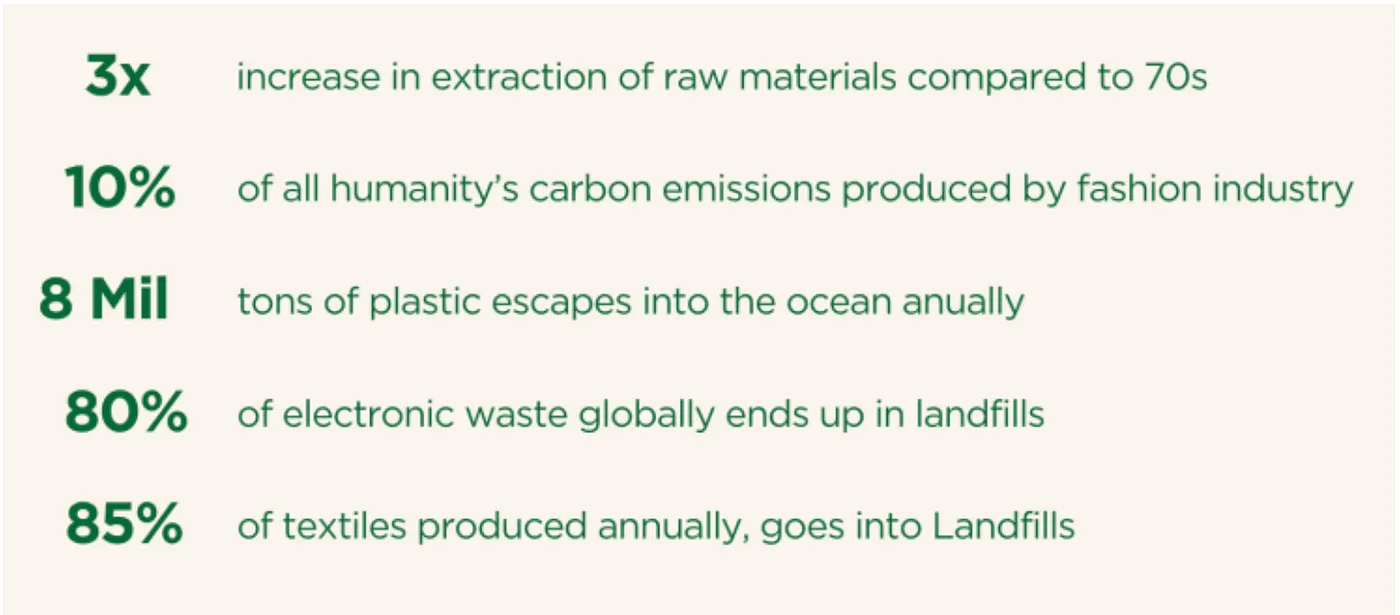
Demand for sustainable, do-it-yourself solutions is growing fast.
Recent studies indicate a growing awareness among consumers about environmental issues and a rising demand for sustainable products. According to a Nielsen survey, 73% of global consumers say they would definitely or probably change their consumption habits to reduce their environmental impact. [Source]
Moreover, the DIY home improvement market, which includes up-cycling, is growing rapidly. For instance, the revenue generated in the DIY & Hardware Store market in 2024 amounts to US$660.00 billion and is projected to continue growing in coming years. [Source]
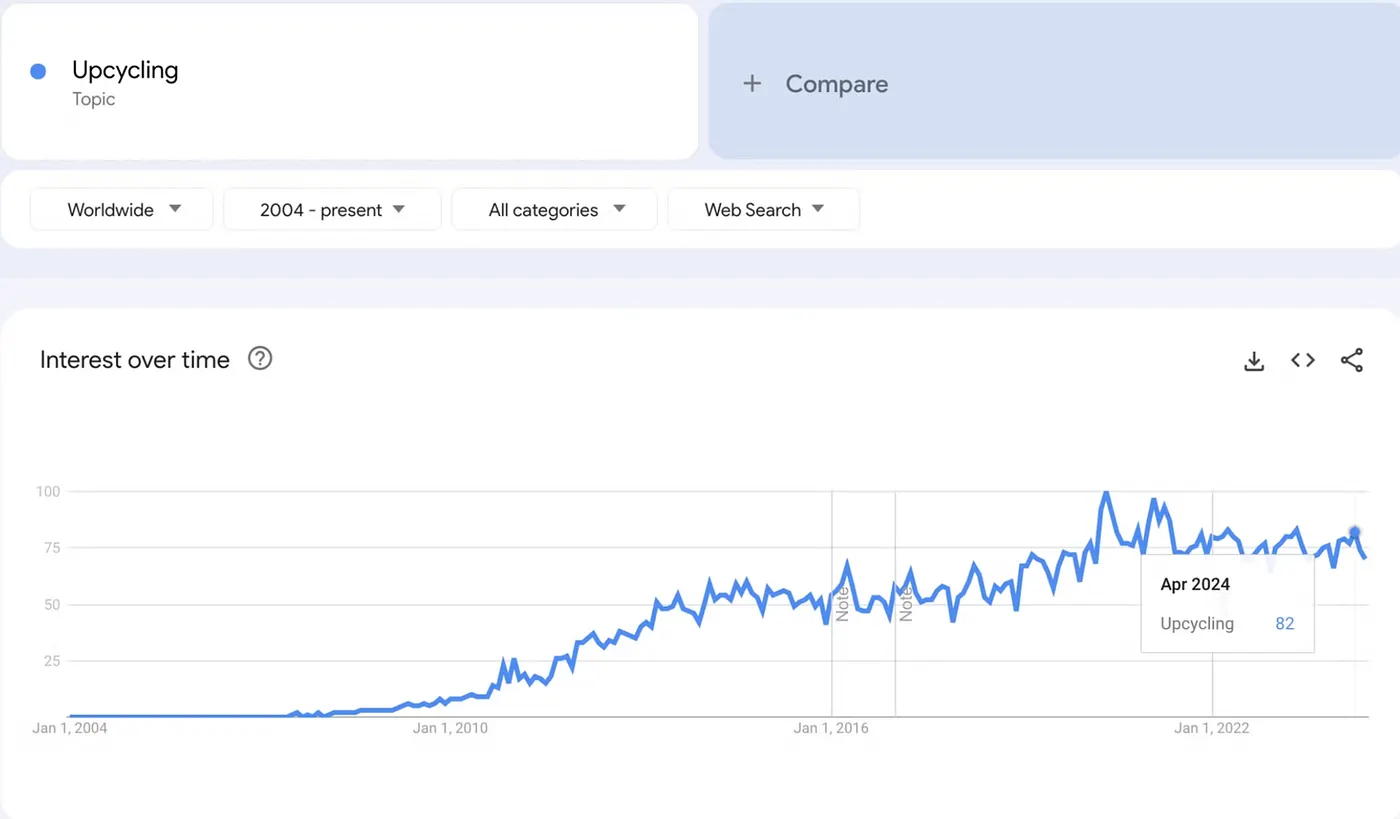
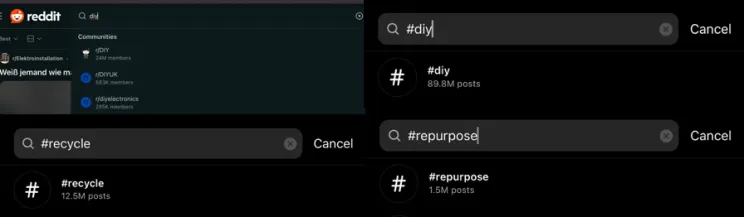
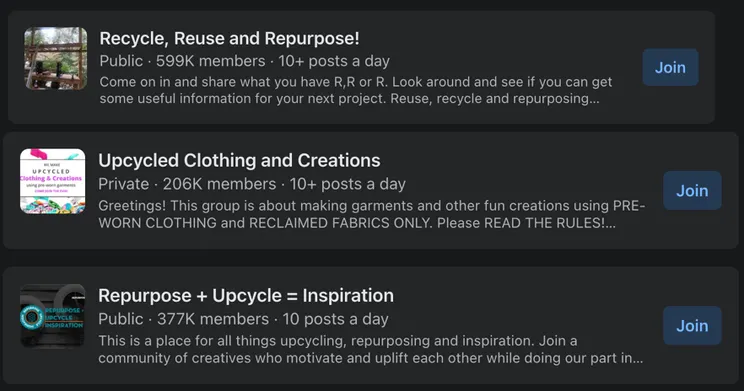
To further validate the demand for DIY, recycling, and up-cycling, I also explored various social media platforms, including Facebook groups, Reddit, Instagram, and Pinterest, as well as Google Trends for keyword such as "upcycling". These platforms host thriving communities dedicated to sustainable living and creative repurposing. On Facebook and Reddit, numerous groups and forums have thousands of active members who regularly share up-cycling projects, tips, and success stories. Instagram and Pinterest are filled with visually appealing content showcasing innovative up-cycling ideas and DIY tutorials, garnering significant engagement in the form of likes, comments, and shares.
The strong presence and active participation in these online communities underscore a growing interest and demand for sustainable practices, further validating the need for a dedicated app that leverages generative AI to provide personalised and practical up-cycling solutions.
11 questions, two languages, 28 responses.
In order to further understand the needs of the target group, a survey consisting of 11 questions was carried out in German as well as in English language.
The survey was distributed in a digital manner was shared to the target audiences on different platforms such as Reddit, Facebook, etc. where total of 28 responses were received. Details related to the following areas were gathered via the survey:
- —Demographics (Age, occupation, Gender, etc.)
- —Frequency of engagement in repurposing or up-cycling projects
- —Type of items commonly repurposed, if any
- —Motivation to recycle, repurpose
- —Potential interest in a tool helping with generative creative ideas
- —Main challenges faced during repurposing the items
- —Functionalities they would find valuable
- —Likelihood of using such tool in future
Responses were received from participants of various age groups i.e under 18 to over 65. However, the most responses were received from the participants between the age group of 25–34 and 45–54, with 16 participants being “male”, 11 being “female”, and 1 opting for ‘other’.
The participants' occupations vary significantly, including students, individuals working in technical fields, the health industry, business owners, teachers, and retirees.
12 of the participants said that they engage in activities related to DIY, Up-cycling approximately once in a year, 6 participants chose the option 'several times a year', 9 chose 'minimum of once a month' and 1 participant opted for 'Never (I do not repurpose items at all)'. When asked what kind of items do they mostly recycle or repurpose, Electronics, Household Items, Furniture and Clothing were the top responses. Some of the participants also answered with option 'Packaging Material'.
For most of the participants, the top motivations to get involved into up-cycling included "Environmental Concern", "Financial Savings", and some of them owing a creative outlet. One of the participant answered with "Minimalism".
Upon asking how interested would they be in using a digital tool that helps generate creative ideas for repurposing, based on your old items, most of the participants answered with 'Extremely Interested' and second highest selected response being 'Very Interested'.
Most participants cited 'lack of ideas or inspiration' as the primary challenge when it comes to recycling. The second most common issue was 'difficulty in understanding how to repurpose certain materials', followed by concerns such as 'time constraints' and 'lack of tools.'
For most of the participants, the option chosen as most valuable feature was "Suggestions for Creative Projects", the second most wished feature being "Step by Step guidance" and third important being feature "Information on tools and materials needed". Some of the participants also showed interest in having a possibility to share their projects with others.
Based on the survey results, several pain points and user needs emerge among participants interested in recycling and up-cycling. The primary pain points include a 'lack of ideas or inspiration' and 'difficulty in understanding how to repurpose certain materials'. Participants also expressed concerns about 'time constraints' and 'lack of tools' hindering their efforts.
Their occupational diversity, ranging from students to retirees, suggests a broad spectrum of interests and challenges. Key needs identified include the desire for 'Suggestions for Creative Projects' as the most valued feature, followed closely by a need for 'Step-by-Step Guidance' and 'Information on Tools and Materials Needed'.
Additionally, participants expressed interest in a digital tool that generates creative ideas for repurposing based on their old items, indicating a strong appetite for practical solutions that support their recycling endeavours. Finally, there is a notable interest in sharing projects with others, highlighting a social aspect to their engagement in recycling activities.
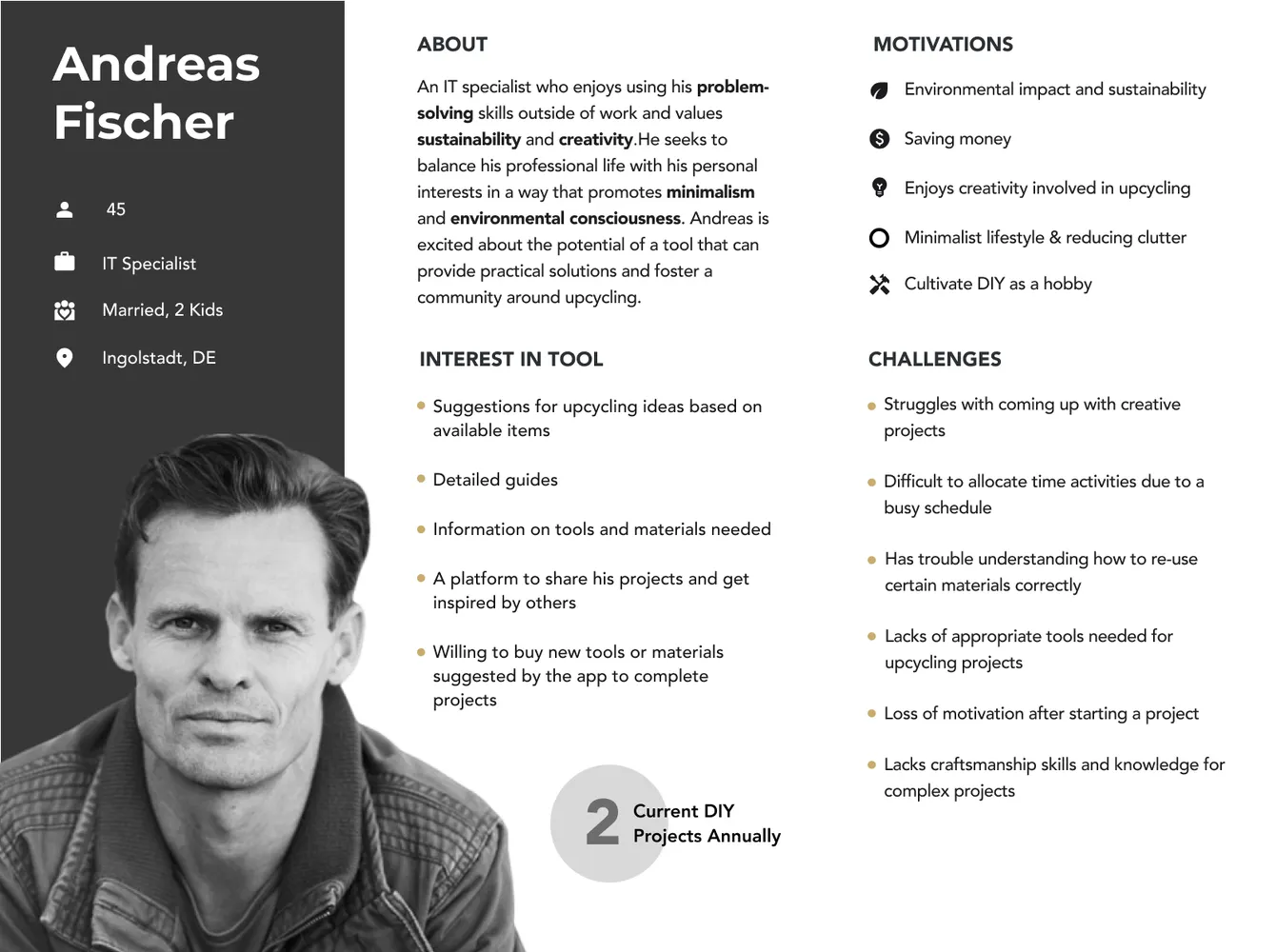
Meet the upcycler the research pointed to.
The following persona was created to represent the target users, based on the research.
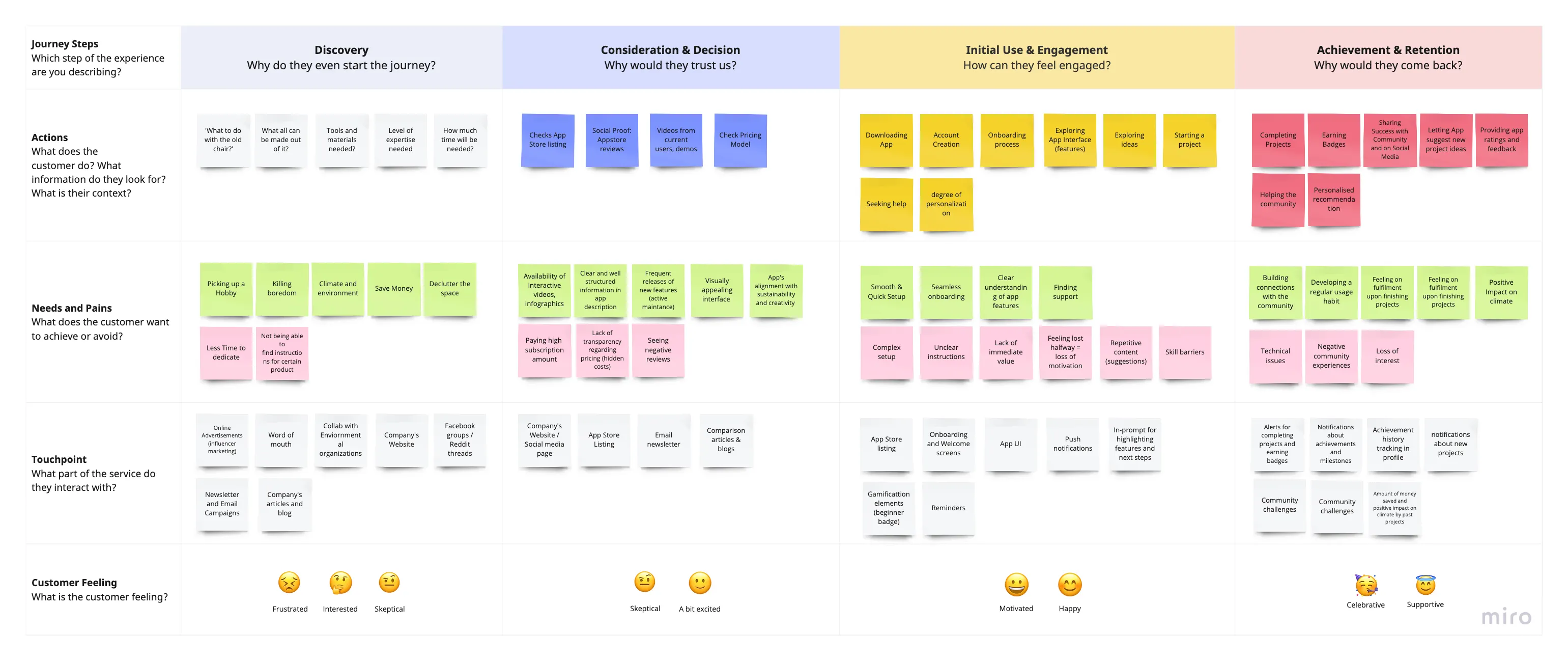
Mapping the journey from clutter to creation.
Below diagram shows the journey of a potential customer based on the data gathered from research.
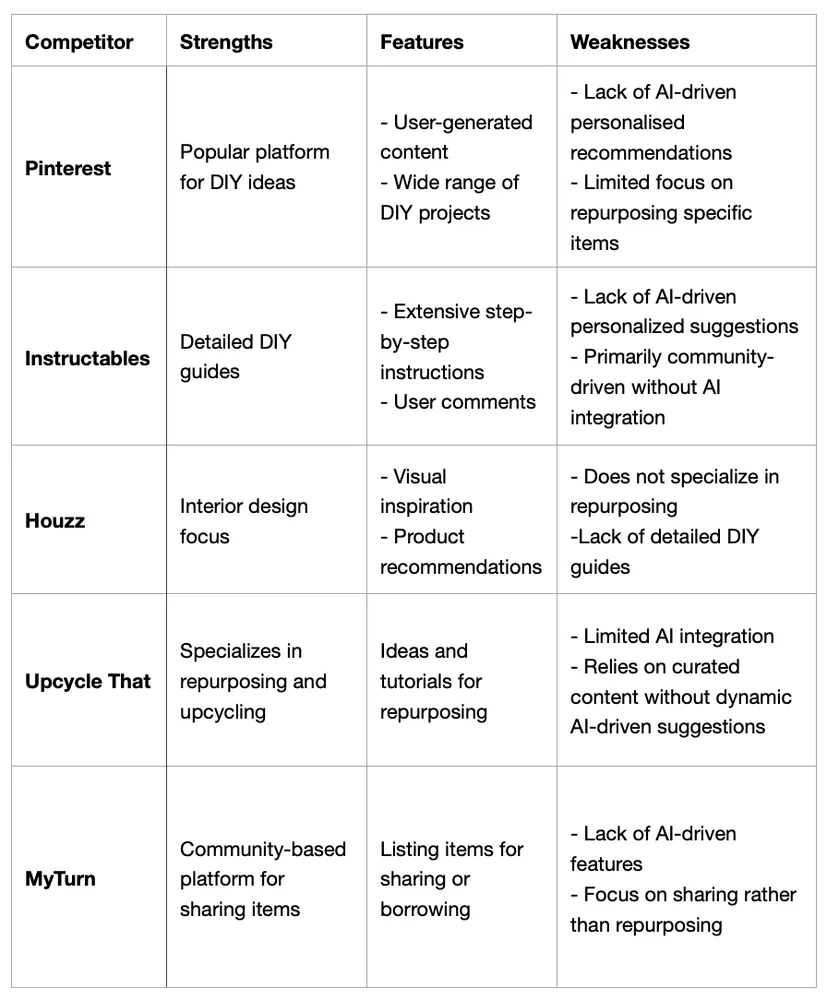
Where today's DIY platforms fall short.
To provide a brief analysis of these popular DIY platforms, I've outlined their strengths and weaknesses in the table below. This comparison highlights key features and limitations to offer a clear overview of each platform. The table below offers a clear comparison of these popular platforms, highlighting their strengths and weaknesses.
Scan an object, get practical ideas for reusing or upcycling it.
With the recent advancements in the field of Generative Artificial Intelligence, it is now possible to offer a promising solution that provides personalised, creative, and practical suggestions for repurposing items.
By analysing images of user's old belongings, the AI can generate customised up-cycling ideas, complete with visual representations, step-by-step instructions, and a list of required materials and tools. Additionally, a community feature can provide social support, inspiration, and knowledge sharing among users. This approach has the potential to transform waste management practices, reduce environmental impact, and foster a culture of sustainability.
Personalised Repurposing Suggestions
Utilise advanced Generative AI to analyse images of user's old belongings by scanning the surroundings or a specific object, and generate custom upcycling ideas.
Visual Simulations
Provide visual representations or simulations showing how repurposed items could appear.
Step-by-Step Guides
Offer detailed instructions, including lists of required materials and tools, to guide users through each upcycling project.
Community Engagement
Foster an active community where users can share their projects, collaborate, and exchange knowledge and inspiration.
Sustainability Focus
Promote environmental impact reduction through repurposing and recycling practices.
From screen flow to a high-fidelity prototype.
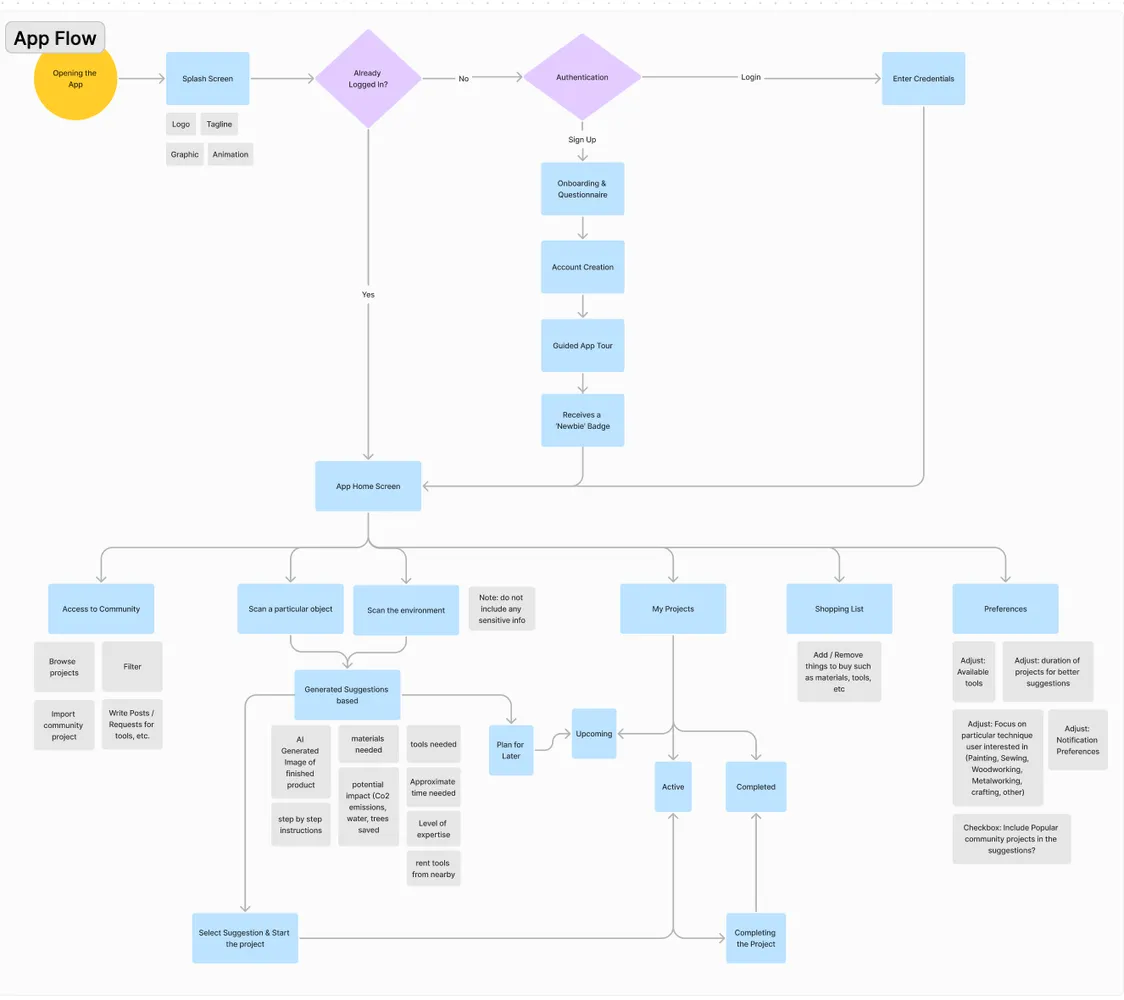
I initiated the design process by developing a comprehensive screen flow, which illustrates how users will navigate through the app and highlights the features available at each stage. This step allowed me to better visualise user's journey through the app.
The flowchart below illustrates the application's workflow. Blue rectangular elements represent specific screens, while grey rectangular elements depict functions or features included on those screens.
After finalising the flow and wireframes, I moved towards designing high-fidelity screens where I used the same wireframes and refined them into high-fidelity screens. This stage also involved focusing on visual details, aesthetics, and establishing the app's branding. I focused on giving the app a cohesive and appealing look and feel throughout the interface.
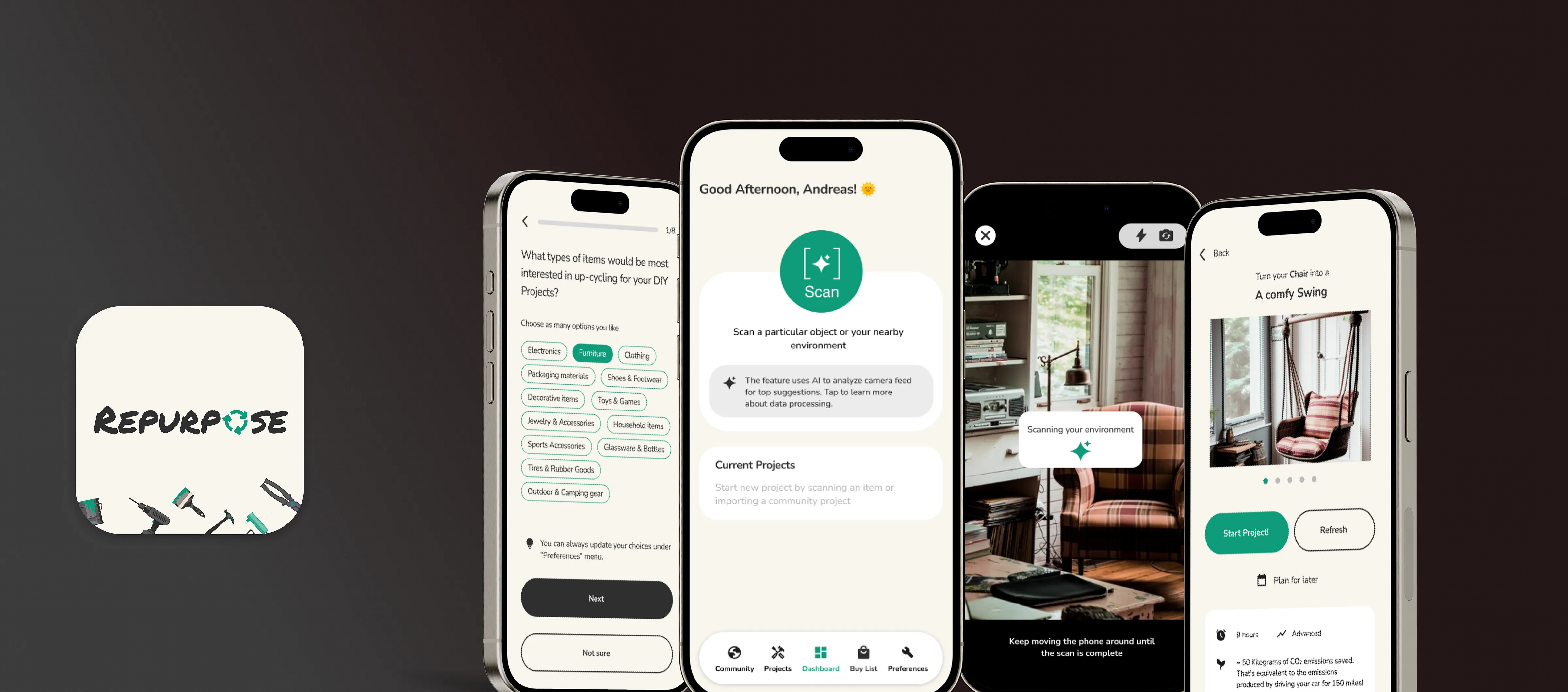
Watch a prototype video showcasing the AI generation feature in action:
The full high-fidelity Figma file is embedded below.
Tested on a real device, then iterated.
To gather feedback, users were asked to test the app prototype on a real iPhone 14 Pro Max. Below is an example of user comments highlighting areas where potential improvements can be made:
"How can I search for interesting projects without scanning an object or the surroundings?"
The above possibility was addressed as a feature under 'Community' menu where a user can directly import a project of their wish. Also added in the "App Flow" diagram as a feature. Once the project is imported, the project should appear under 'Projects' menu, and can either be started directly or can be planned for a later date.